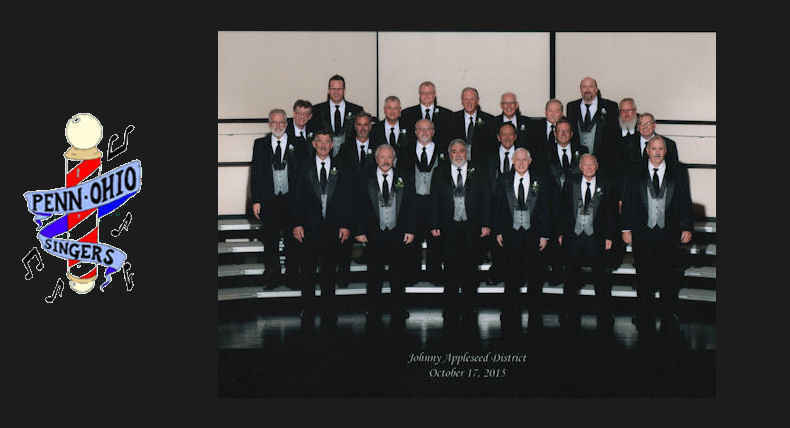
The Penn-Ohio Singers are proud to be singers and preservers of barbershopmusic. The Barbershop Harmony Society allows us to make great music and build lasting friendships. You may have some questions like these:What is barbershop? Barbershop is a style of music that has become one ofthe most recognizable both in and out of the music community. However, what makes a particular arangement "barbershop" and not jazz, doowop, orany other form of a cappella music? Technically, barbershop harmony is made up of four voices. Three of the voices harmonize to the melody,normally sung by the lead part. The tenor harmonizes above the lead, while the bass sings the lowest harmonizingnotes. The baritone part provides 'in-between' notes, like the 'barbershop' seventh, that gives barbershop its originaland rich sounds. Another notoriety of barbershop music are the musical embellishments called swipes and tags. Without any sort of musical instruments for backing, barbershop singers need a way to add a forward motion to the music. This is accomplished by the progression of two or more chords on a single word or syllable. Tags are the endingportion of a song, and are most often the most memorable part. They are most often the most practiced and powerparts of a given song. Singing tags is an excellent way to understand the texture in the music. Many barbershoppers know at least one ortwo tags right off of the top of their heads. Singing these tags lets singers understand the effect of proper vowel placement, because of the low amounts of notes and words to remember. By focusing on vowel placement, volume balancing, tone quality, other musical components, singers can really make chords lock and ring. How did the society start? Determined to stem that decline, they wrote a humorous letter to friends, stating: "In this age of dictators and government control of everything, about the only privilege guaranteed by theBill of Rights not in some way supervised or directed is the art of barbershop quartet singing.Without a doubt, we still have the right of peaceable assembly which, we are advised by competent legal authority, includes quartet singing. The writers have, for a long time, thought that something should be done to encourage the enjoyment of this last remaining vestige of human liberty. Therefore, we have decided to hold a songfest on the roof garden of the Tulsa Club on Monday, April 11, 1938, at 6:30 p.m." Twenty-six men attended that first rooftop meeting, and all agreed they should do it again. Attendance at subsequent meetings multiplied rapidly; at the third gathering, more than 150 harmonizers raised such a sound that traffic stopped on the street below. A reporter for the Tulsa Daily World chanced to pass by the scene, sensed a good story, and put the story on the national news wires. The lengthy name and initials, founder Cash's way of poking fun at the New Deal's "alphabet soup" of initialed government agencies, captured the imagination of readers coast to coast, and inquiries came pouring in. Board Officers | Contacts | Photos | POS Schedule | Booking | Quartets | Audition Info Listen To Us | About Barbershop | Members Only |